Plato & Aristotle
This is usually the first topic you learn about when you take A-Level RS.
The point of this topic is to be able to compare Plato & Aristotle and understand how their theories relate to knowledge about the world.
Questions you get about this topic in exams is to evaluate whose theory of reality is better, Aristotle's empirical approach or Plato's rational approach.
Heraclitus said that a person never steps in the same river twice as both the river and person change. The world is in a state of constant flux. If everything we experience is constantly changing then this brings into question the possibility of knowledge. Plato and Aristotle, in very different ways, attempt to respond to this issue.
Also: Heraclitus was way ahead of his time for saying this but I do want to point out that he is also rumoured to have covered himself is manure to cure an illness and died so...

Plato's Rationalism
-
Plato believed that true knowledge comes from reason (the intellect), not from the senses.
-
The senses give us only opinions or ignorant beliefs about the changing physical world, which is unreliable and deceptive.
-
Knowledge is achieved through rational reflection, not sensory experience.
Plato's Forms
-
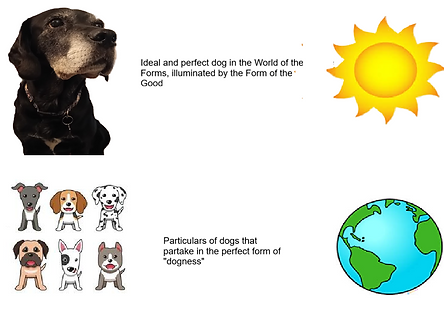
Our minds are trapped in ignorance, which is why we experience imperfect, transient, and ever-changing things in the world of appearances (Earth).
-
True reality is perfect, eternal, and unchanging. Plato calls this the world of forms. Only by understanding the forms can we achieve true knowledge.
-
Everything we see in the world of appearances is a ‘particular’, the objects of everyday experience.
-
Particulars are imperfect, temporary representations of the forms they partake in.
-
When I look at a tree, I am really perceiving the perfect, eternal, and immutable form of treeness. My senses, however, show me only a particular tree, which is transient and subject to decay.
-
The tree gets its 'treeness' by ‘partaking’ in the form of treeness. It’s like seeing an object in a broken mirror, a distorted reflection of the real thing.
-
In Plato’s view, we perceive the forms through the broken lens of our ignorance.
-
We gain knowledge of the world of forms through a priori reasoning, not through empirical experience, which gives us only vague shadows of reality.

Plato's Allegory of the Cave
-
There are prisoners who are chained inside a dark cave from birth. They are only able to look forwards at a wall.
The prisoners are us and the chains are our ignorant state of mind. We are unable to see anything else.
- Behind the prisoners there is a fire and between the flames and prisoners is a walkway where objects are carried.
The objects that are carried are inspired by real things that can be found outside of the cave. They are representations of forms.
- The prisoners only see the shadows reflected on the wall and believe the shadows are reality.
The shadows are reality for the prisoners because they have never seen anything else.
- A prisoner is freed and escapes the cave towards the sunlight.
- When the prisoner leaves the cave he is initially blinded by the sunlight but gradually sees real objects and the sun.
The outside world is the world of the forms and the sun is the Form of the Good.
- The freed prisoner returns to the cave and attempts to tell the other prisoners what he has seen but they do not believe him.
Plato's Hierarchy of the Forms
-
Highest Form: The Form of the Good
This is the ultimate form and the source of all forms. It provides truth and knowledge and illuminates understanding.
- Higher Forms: Abstract
These are the perfect, eternal and unchanging ideas that govern concepts and knowledge. They are intelligible and can only be grasped by reason, not the senses. EG: Justice, beauty.
- Lower Forms: Phenomena
These are objects in nature like the perfect tree, dog etc.
- Particulars
These are the reflections of the perfect forms. So the particular of a tree or the particular of a dog.


Plato's Argument from Recollection
-
The argument from recollection is one of Plato’s arguments for both the existence of the soul and the existence of the world of forms.
-
Plato points out that we do have knowledge of perfect, eternal and unchanging concepts like beauty and justice.
-
We also have perfect mathematical concepts and geometric concepts such as the idea of a perfect circle.
-
We have never experienced perfect beauty, justice or a perfect circle. So, we must have gained this knowledge a priori.
-
(Plato's Dialogue 'Meno') Socrates proved that an uneducated slave boy could be prompted by a series of questions and some shapes drawn in the sand to figure out how to solve a geometry question.
-
The slave boy must therefore have been born with geometric concepts.
-
Plato's answer is that we must have somehow gained these concepts before we were born. Our soul existed in a realm where there were perfect forms. In the world of forms there are perfect mathematical forms and perfect forms like the form of beauty and the form of justice.
-
We are born with a dim recollection of the forms because our soul apprehends them before becoming trapped in this world of appearances.
-
Anamnesis is the process of re-remembering these forms through a posteriori sense experience.
-
Plato concluded that the source of knowledge must therefore be a priori.
Aristotle's 4 Causes
-
Aristotle argued that we gain knowledge of the world by analysing it
- Things do change, but we can attempt to understand the reason for that change.
- Potentiality and actuality attempt to describe this change. Potentiality is what something could become and actuality is something that is already fully realised.
- The Four Causes also attempt to explain change in things. They are:
The Material Cause: what something is made of
The Efficient Cause: what made that thing
The Formal Cause: the essence of that thing
The Final Cause: the telos of that thing.
- Potentiality and actuality are related to the four causes because things go through the four causes to become their actuality.


The Prime Mover
-
The Prime Mover is what happens when we apply the four causes to the entire universe.
The Material Cause is all the matter that exists and makes up the universe.
The Efficient Cause is not something the universe has because the universe is eternal
The Formal Cause is the intrinsic order the universe seems to have. It's the rational ordered structure of reality itself.
-
Aristotle believed that things default to being at rest, all objects want to be still. But things keep moving, This means that something is sustaining the constant movement of the universe.
-
The Prime Mover is the Final Cause of the universe, it is that which is responsible for all the motion and change in the universe.
-
The Prime Mover cannot move, nor can it be changed. It is pure actuality.
-
Things in the universe are attracted to the Prime Mover, I always imagine this to be a kind of orbit. It does not push objects itself, everything is drawn to it.
Extra Resources
Here are some extra resources for this topic. Things like essay plans for A* answers. They are paid for, sorry! They're £2 each because they take me a really long time to make :)
![[OCR] Plato Essay Plan](https://static.wixstatic.com/media/fa6229_31867fa861e24a89bddca45949905342~mv2.png/v1/fill/w_306,h_197,al_c,usm_0.66_1.00_0.01/fa6229_31867fa861e24a89bddca45949905342~mv2.png)